


Summary:
Many businesses invest months, sometimes years, in improving their website’s rankings in Google. Traffic increases, leads begin to arrive, and the website finally starts delivering real business value.
Then a natural question appears:
“If the website already ranks well… do we still need to keep doing SEO?
Let’s save some money!”
To answer this question, we analyzed several websites that had previously benefited from strong search visibility but later stopped investing in ongoing optimization.
The results were … impressive!
Across multiple websites, organic traffic declined between 80% and 100% after SEO activities stopped.
In some cases, the loss took a few years.
In others, the collapse happened in less than six months.
This case study reveals what really happens when search optimization is treated as a one-time project instead of a continuous process.
Many businesses invest significant effort into improving their website’s visibility in search engines. They implement technical improvements, optimize their content, build authority through backlinks, and begin to see steady growth in organic traffic.
At some point, however, a common question arises:
“If our website already ranks well, do we still need to continue optimizing it? Can we use the budget somewhere else?”
This case study explores what happened across several websites after search optimization activities were stopped. The results reveal an important reality about search engines and digital visibility: SEO is not a one-time project. It is an ongoing process.
Each of the websites analyzed in this case study had previously invested in search optimization. Their websites had:
For a period of time, these websites benefited from strong performance in search engines such as Google.
However, at different points in time, optimization activities stopped. This meant:
Over time, this lack of continued optimization began to affect performance.
Across multiple websites and industries, a similar pattern emerged.
Once the ongoing optimization stopped, organic traffic gradually declined.
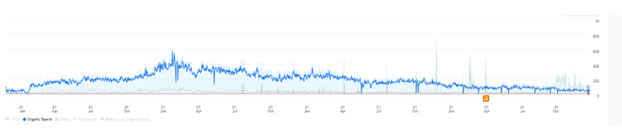
Example 1
Loss of 100% of organic traffic within 15 months
One website experienced a complete collapse in organic search traffic in just over a year after optimization stopped. Rankings gradually declined as competitors continued investing in their own optimization strategies.
Without technical updates or content refreshes, the website eventually disappeared from the first pages of search results.
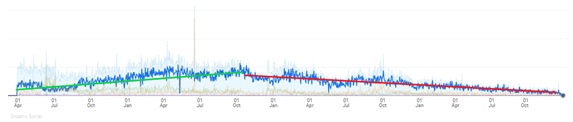
Example 2
95% loss of organic traffic in 3.5 years
Another website maintained relatively stable performance for a period of time. However, as competitors improved their websites and search engine algorithms evolved, the website slowly lost rankings.
After approximately three and a half years, organic traffic had dropped by 95%.
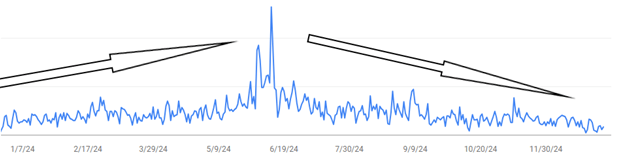
Example 3
80% traffic decline in 2.5 years
In this case, the decline was slower but still significant. Over a period of two and a half years, organic traffic fell by roughly 80%.
Several factors contributed to the decline:
Example 4
92% traffic loss in only 6 months
In one particularly dramatic example, organic visibility declined very rapidly.
Within six months, the website lost 92% of its organic traffic.
This case likely involved additional factors such as algorithm updates or technical issues that were not addressed due to the absence of ongoing optimization.
Example 5
95% organic traffic decline over 3.2 years
A similar long-term decline occurred in another case. After search optimization activities stopped, rankings slowly deteriorated over time.
Within a little over three years, the website had lost 95% of its organic traffic.
Search engines constantly evolve. Google alone releases thousands of updates every year, including several major algorithm changes.
At the same time, competitors continue improving their own websites.
When optimization stops, several things typically happen:
Competitors Overtake Rankings
Businesses that continue investing in optimization produce better content, improve their websites, and build stronger authority signals.
Over time, they replace stagnant websites in search results.
Content Becomes Outdated
Search engines prioritize fresh, relevant, and accurate content.
Without updates or expansion, previously strong content can gradually lose relevance.
Technical Standards Change
Web technologies and performance expectations evolve.
Factors such as:
all continue to develop over time. Without maintenance, websites slowly fall behind current best practices.
Backlink Authority Weakens
Authority signals are relative.
Even if a website does not lose its existing backlinks, competitors may gain significantly more.
This changes the competitive landscape and can reduce ranking strength.
Algorithm Updates Reshape Rankings
Search engines regularly update how they evaluate:
Websites that are not monitored and adjusted can be negatively affected by these updates.
One of the most common misconceptions in digital marketing is that SEO is something you “finish.”
In reality, search optimization is much closer to business maintenance than to a one-time setup.
A helpful comparison is physical fitness.
You can invest months improving your fitness and reach excellent results. However, if you stop training entirely, those results gradually decline.
Search visibility works in a similar way.
The goal of ongoing SEO is not only to grow traffic but also to protect and maintain the visibility already achieved.
Long-term search performance typically requires ongoing work in several areas:
Technical Website Maintenance
Regular audits ensure the website continues to meet evolving technical standards.
Content Development and Updates
New content helps capture emerging search opportunities while updates maintain the relevance of existing pages.
Authority and Link Building
Continued authority growth helps maintain competitive strength.
Monitoring Search Performance
Tracking rankings, traffic, and algorithm updates allows issues to be identified and corrected early.
Adapting to Changing Search Behavior
Search queries, user intent, and industry topics evolve over time.
While the examples in this case study show dramatic organic traffic losses after SEO activities stopped, it is important to note that multiple variables can contribute to these results, including:
However, in every case analyzed, the absence of ongoing optimization meant that these issues were not detected or corrected in time.
 Optimized by Seraphinite Accelerator